What Is Skin Cycling? The 4-Night Scientific Routine
Prepared by Pharmacist Berfin Işık. As a pharmacist specializing in pharmaceutical and cosmetic formulations, she follows current scientific literature on active ingredient safety and skincare routines. This content is for informational purposes only and is not a substitute for medical advice.
Skin cycling is the most talked-about skincare approach of the last two years; and contrary to its popularity, there’s solid reasoning behind it: instead of using potent active ingredients every night consecutively, queuing them in a cycle preserves their efficacy while minimizing irritation. In this guide, we'll delve into what skin cycling is, why it works, and break down the 4-night cycle step-by-step from a pharmacist's perspective.
What is Skin Cycling?
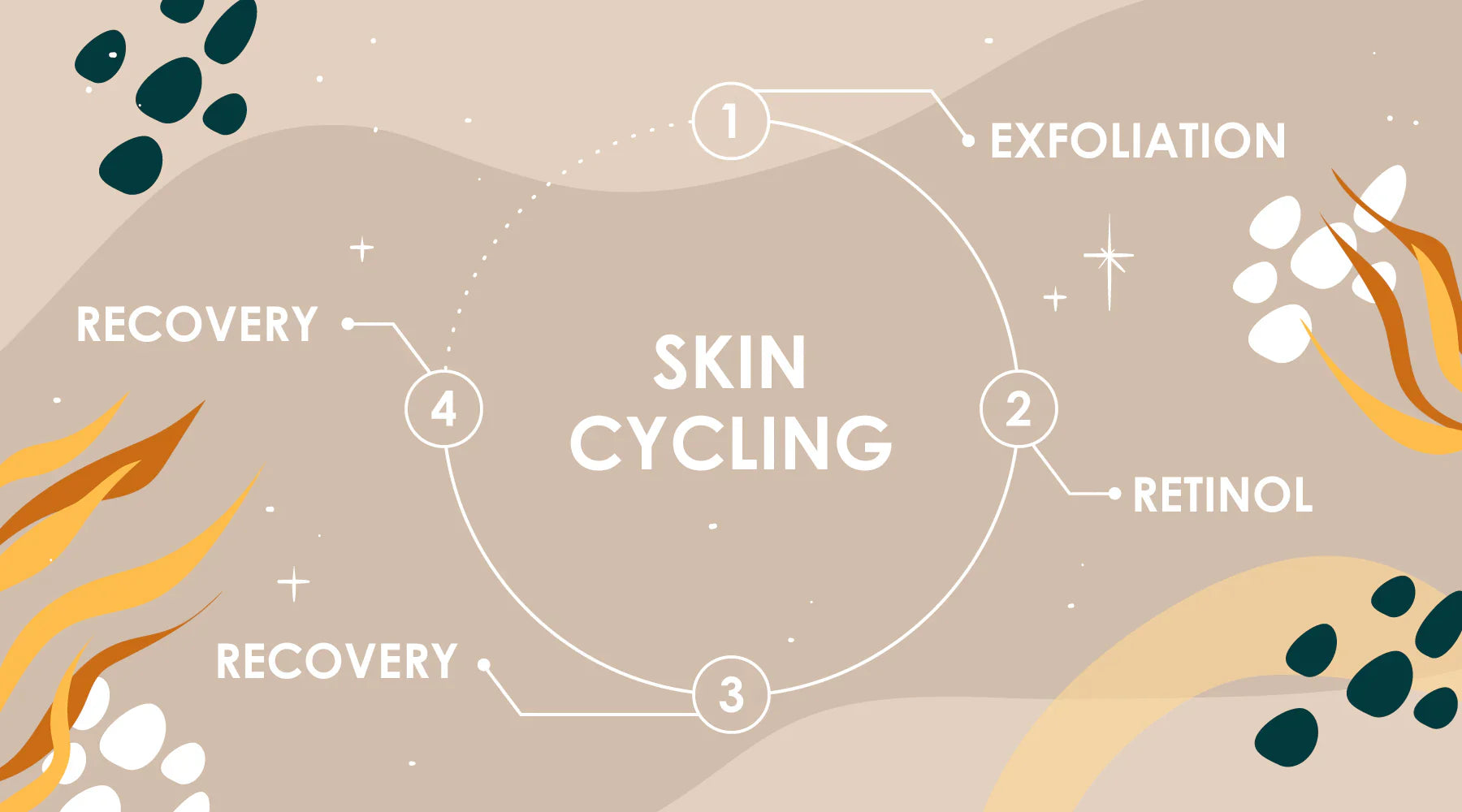
Skin cycling is a structured approach popularized by dermatologist Whitney Bowe that organizes the nighttime routine into a repeating four-night cycle. The logic is simple: two "active" nights (one exfoliation, one retinoid) followed by two "recovery" nights. Recovery nights compensate for the stress caused by the active ingredients, allowing the skin barrier to repair itself. This prevents chronic irritation, dryness, and barrier damage, which are often misconceptions of "more active = better results."
Why Does It Work? The Scientific Logic
Retinoids and chemical exfoliants (AHA/BHA/PHA) are among the most proven anti-aging and renewing active ingredients; however, both create stress on the barrier. Using them consecutively on the same night significantly increases cumulative irritation—burning, redness, peeling. Skin cycling spreads this stress over time: each active ingredient is on the skin long enough to be effective, but the skin finds a repair window before the next active.
Scientific literature supports this logic. AHAs (especially glycolic and lactic acid) accelerate cell turnover, increase collagen and elastin synthesis, and improve texture and blemish appearance; however, as concentration and frequency increase, irritation symptoms like burning and stinging also rise. PHAs (gluconolactone), a gentler alternative, have been shown to provide similar anti-aging benefits to AHAs while being significantly better tolerated. Retinoids, on the other hand, stimulate fibroblasts and suppress MMP enzymes, providing dermal-level renewal but causing a temporary irritation period known as "retinization." Skin cycling is a practical way to use these two powerful tools sequentially without them clashing.
The 4-Night Cycle — Summary Table
| Night | What to Do? | Purpose |
|---|---|---|
| Night 1 — Exfoliation | Chemical exfoliant (AHA/PHA/BHA) after cleansing + moisturizer | To remove dead cells and prepare for absorption of subsequent active ingredients |
| Night 2 — Retinoid | Retinol/retinoid on clean, dry skin + moisturizer | Collagen synthesis, texture, and blemish renewal |
| Night 3 — Recovery | Only soothing, barrier-repairing moisturization | To repair the barrier, compensate for moisture loss |
| Night 4 — Recovery | Gentle moisturization + soothing care again | To start the next cycle with rested skin |
How to Apply Night-by-Night?
Night 1 (Exfoliation): After a gentle cleanser, apply a chemical exfoliant to dry skin. For sensitive or beginner skin, PHA or a low-percentage AHA is the safest starting point. Follow with a moisturizer. Physical scrubs are not used at this step.
Night 2 (Retinoid): Apply a pea-sized amount of retinol to clean and completely dry skin; wet skin increases irritation. For sensitive areas, the "sandwich technique" (moisturizer → retinol → moisturizer) reduces irritation. If you're new to retinol, check out our guide on retinol and its derivatives.
Nights 3 and 4 (Recovery): No active ingredients. Only soothing, barrier-friendly moisturization is applied. Repairing ingredients like niacinamide, ceramides, beta-glucan, Centella, and panthenol are the stars of these nights. We've explained in detail why the skin barrier is so important in our skin barrier guide.
When the cycle ends, it restarts. If the skin is very sensitive, the cycle can be extended to 5–6 nights (e.g., three recovery nights instead of two); if the skin is very resilient, active nights can be made more frequent over time. Skin cycling is not a strict rule but a customizable framework.
Who is it Suitable For, and Who Should Be Cautious?
Skin cycling is ideal for those new to retinol or acids, those with sensitive and irritation-prone skin, and those who have overused active ingredients every night, tiring out their barrier. During the day, a broad-spectrum SPF is an indispensable part of this routine; both retinoids and AHAs increase sun sensitivity. In cases of active eczema, uncontrolled rosacea, or open wounds, active ingredients should be paused, and focus should be placed solely on reparative care. During pregnancy and breastfeeding, the retinoid night should be replaced with an alternative containing bakuchiol or peptides.
Recommended Products


Frequently Asked Questions
Can every skin type implement skin cycling?
Yes, but the cycle should be adapted to the skin type. Sensitive skin should use a gentle exfoliant like PHA and apply it less frequently, increasing recovery nights. Oily and resilient skin can increase the frequency of active nights over time. The key is to listen to your skin and increase recovery nights at the first signs of irritation.
Which acid should I choose for exfoliation night?
For dry/sensitive skin, lactic acid or PHA (gluconolactone) is the gentlest option. Salicylic acid (BHA) is suitable for oily skin and those with pore/blackhead concerns. Glycolic acid is the most potent AHA; it's effective but carries a higher potential for irritation, so it should be chosen based on tolerance.
Is it necessary to use active ingredients on recovery nights?
No; the purpose of recovery nights is precisely to avoid active ingredients. During these nights, only soothing and barrier-repairing moisturizers (ceramides, niacinamide, beta-glucan, Centella, panthenol) are used. This "rest" is the part that makes the cycle effective.
What should I do during the day?
Skin cycling is a nighttime routine. The most critical step during the day is broad-spectrum SPF 30+ sunscreen; both retinoids and acids make the skin more sensitive to UV. If desired, morning antioxidants (vitamin C) and moisturizer can be added.
Conclusion
Skin cycling is a barrier-friendly nighttime routine framework that intelligently sequences powerful active ingredients, ending the "more actives" race. Two active nights, two recovery nights, and consistent sun protection; this simple rhythm reduces irritation while preserving the proven benefits of retinoids and acids. You can get support from Medicblu experts to design a cycle tailored to your skin.
References
- Almeman AA. Evaluating the Efficacy and Safety of Alpha-Hydroxy Acids in Dermatological Practice: A Comprehensive Clinical and Legal Review. Clin Cosmet Investig Dermatol. 2024;17:1661-1685. PMID: 39050562 · DOI: 10.2147/CCID.S453243
- Edison BL, Green BA, Wildnauer RH, Sigler ML. A polyhydroxy acid skin care regimen provides antiaging effects comparable to an alpha-hydroxyacid regimen. Cutis. 2004;73(2 Suppl):14-17. PMID: 15002657
- Mukherjee S, Date A, Patravale V, et al. Retinoids in the treatment of skin aging: an overview of clinical efficacy and safety. Clin Interv Aging. 2006;1(4):327-348. PMID: 18046911 · DOI: 10.2147/ciia.2006.1.4.327