Gua Sha and Facial Massage: The Truth About Lymphatic Drainage
Prepared by Pharmacist Berfin Işık. Pharmacist and specialist in dermocosmetics and active ingredients. This content is for informational purposes only and is not a substitute for medical advice.
Gua sha and facial massage have become some of the most talked-about skincare rituals on social media in recent years, yet what these techniques actually do is often confused with marketing promises. In this article, we look at the real effects of the gua sha stone and manual facial massage on the skin, namely lymphatic drainage, blood circulation, support for product absorption and temporary reduction of puffiness, together with the level of scientific evidence for each. Let us begin with an important caveat: the available evidence is limited, and gua sha is not a permanent lifting method. Our aim is to set out a framework of realistic expectations, correct technique and safe use.
What Are Facial Massage and Gua Sha?
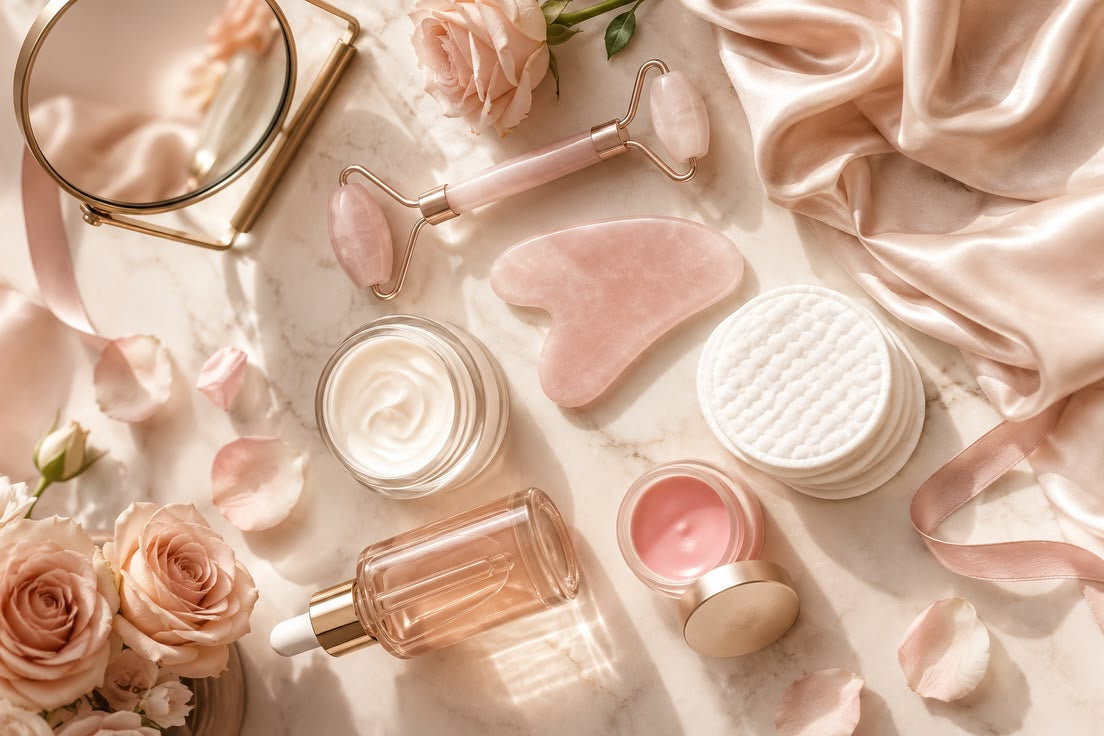
Facial massage is the general term for rhythmic pressure and gliding movements applied to the skin and the underlying soft tissue with the fingertips or a tool. Gua sha, on the other hand, is a technique from traditional East Asian medicine in which a smooth-edged stone (usually jade or quartz) is glided across the skin at specific angles. Unlike the traditional body practice, modern gua sha on the face is performed with much lighter pressure; the goal is not to cause bruising but to gently support circulation and tissue mobility. Both methods affect the tissue through mechanical stimulation; they differ in the intensity of pressure, the contact surface and the angle of application.
Lymphatic Drainage and Blood Circulation: The Mechanism
The superficial lymphatic network beneath the skin collects interstitial fluid and waste molecules and carries them back into circulation. Gentle, directed massage movements may temporarily support the movement of this superficial fluid; because part of the mild facial puffiness seen in the morning comes from this accumulated fluid, the face may look more "defined" after a massage. This effect is physiologically real, but it is temporary and does not permanently reshape the tissue.
On the blood circulation side, the evidence is clearer. A short application with a facial massage tool has been shown to significantly increase skin blood flow (SkBF) in the treated cheek for at least 10 minutes after the massage, while regular use has been shown to improve the vasodilatory response to heat stimulation. Vigorous rubbing of the skin has also been reported to cause temporary vasodilation (widening of blood vessels) and redness, partly through the release of a neurotransmitter called substance P. In other words, the instant glow and rosiness after a massage is a real but short-lived circulatory response.
Support for Product Absorption
A frequently cited benefit of gua sha and facial massage is that serums and moisturizers are "absorbed better." It is true that mechanical massage helps even out the application surface and spread the product across the skin; in addition, increased surface circulation and warmth may make it easier for some formulas to spread over the skin. However, this should not be overstated: massage does not dramatically change, in a clinical sense, the rate at which an active ingredient passes through the stratum corneum barrier. In practice, the most tangible benefit is that massage slows down your application and helps you spread the product evenly over every area. To read in more detail about how the skin barrier works and why product penetration is limited, you can take a look at our skin barrier guide.
Effects on the Skin
| Effect | Explanation and Level of Evidence |
|---|---|
| Temporary increase in blood circulation | Massage with a tool or by hand briefly increases skin blood flow in the treated area. Level of evidence: reasonable (small clinical studies). |
| Temporary reduction in puffiness | By supporting the movement of superficial lymphatic fluid, morning puffiness may be reduced for a while. The effect is temporary. |
| Instant glow and rosiness | Vasodilation and the release of substance P cause temporary redness and a refreshed look in the skin. |
| Relaxation and muscle loosening | The feeling of tension in the jaw and temple area may decrease; this is a subjective comfort effect. |
| Product distribution | Helps serums and creams spread evenly over the surface; does not change the absorption rate to a clinical degree. |
| Permanent lifting / contour change | Not proven. The geometry of the facial tissue does not change permanently. |
Scientific Evidence and Its Limits
Research on gua sha and facial massage is generally small-sample, short-term and pilot in nature. Laser Doppler measurements have shown that gua sha markedly increases surface microcirculation in the treated area; however, this does not validate facial rejuvenation claims. Reviews in the dermatology literature evaluating gua sha, jade rollers and facial massage emphasize that these tools have a reasonable rationale in terms of circulation and relaxation, but that there is no high-quality evidence to support cosmetic claims such as wrinkle reduction or permanent firming.
In addition, the anatomical reality behind the perception of a facial "lift" is also limited: studies examining the vertical mobility of facial soft tissue show that massage can temporarily displace the tissue, but that the structure, which depends on gravity and tissue elasticity, is not permanently reshaped. In short, the effect of massage is real, but temporary and modest. For anti-aging results, the role of evidence-based active ingredients is far more decisive; our article on the active ingredients every anti-aging routine should include can guide you on this topic.
Correct Technique: Safe Application Step by Step
- Clean skin and a clean tool. Cleanse your face before application, and wash and dry the gua sha stone after every use. A dirty tool can lead to clogged pores and irritation.
- Use a moisturizer. Never glide over dry skin. Apply a facial oil, a slip-providing serum or a moisturizer to reduce friction between the stone or your fingers and the skin. This prevents tugging and micro-irritation.
- Light pressure. On the face, the goal is not bruising. Keep the pressure light and hold the stone flat against the skin at an angle of about 15 degrees.
- From the center outward, from bottom to top. Work from the middle of the face toward the ears and down the neck, using gentle movements that support the direction of lymph flow. 3-5 repetitions per area are sufficient.
- Take care around the eyes. The skin in this area is thin; approach it separately, with a very light touch and preferably with an eye care product. For details on under-eye puffiness and dark circles, you can read our under-eye care guide.
- Do not overdo the duration. 5-10 minutes a day is sufficient; longer and more aggressive application does not increase the benefit, it increases the risk of irritation.
Who Should Be Careful? Excessive Pressure and the Risk of Couperose
The most common mistake is excessive pressure. Facial skin is thin and highly vascular; vigorous rubbing can pave the way for repeated mechanical trauma, dilation of capillaries and the appearance of persistent redness (couperose/telangiectasia). In conditions such as rosacea, couperose, active acne, eczema or sunburn, gua sha and vigorous massage are generally not recommended; in these skin types, mechanical stimulation can trigger redness and flare-ups. For controlling redness and managing skin with sensitive circulation, we recommend taking a look at our rosacea management guide. During periods when you use retinol or strong acids, the skin may also be more fragile, so reduce the massage pressure or take a break.
Care Products at Medicblu to Accompany Your Massage
As our store does not carry a separate gua sha stone, we recommend the products below as care that provides slip for the massage and supports the skin afterward: a facial oil, which is an ideal slip agent that reduces friction while gliding; dedicated care for the delicate eye area; and masks that repair the skin overnight after the massage. Never massage dry skin; first apply a thin slip layer (for example, a facial oil).


Frequently Asked Questions (FAQ)
Does gua sha permanently slim or firm the face?
No. The available evidence shows that the effects of gua sha and facial massage are temporary. The more defined look seen after a massage is mostly related to fluid movement and increased circulation; it returns to its previous state within a few hours. Permanent contour change should not be expected from these methods.
Can gua sha be done every day?
For healthy, non-sensitive skin, 5-10 minutes a day with light pressure and a slip agent generally does not cause problems. However, if redness, tightness or irritation occurs, reduce the frequency. If you have rosacea, couperose or active acne, avoid daily application.
Does facial massage help products absorb better?
Partially. Massage helps spread the product evenly over the surface and temporarily increases circulation, but it does not clinically significantly change the rate at which an active passes through the barrier. The main benefit is that it slows down your application and helps you distribute the product evenly over every area.
Can I use my fingers instead of a gua sha stone?
Yes. Gentle facial massage by hand provides similar circulation and relaxation effects. What matters is not the tool but light pressure, the right direction and the use of a slip agent.
Conclusion
Gua sha and facial massage are enjoyable rituals that temporarily increase blood circulation, briefly reduce morning puffiness and provide relaxation. However, claims such as permanent lifting, wrinkle removal or facial slimming are not scientifically supported, and the level of evidence is limited. The most sensible approach is to see this technique, used with a clean tool, light pressure and a good slip agent, as a step that complements an evidence-based skincare routine. For a personalized plan suited to your skin type and goals, you can take advantage of our free skincare consultation.
References
- Miyaji A, Sugimori K, Hayashi N. Short- and long-term effects of using a facial massage roller on facial skin blood flow and vascular reactivity. Complement Ther Med. 2018;41:271-276. PMID: 30477852 · DOI: 10.1016/j.ctim.2018.09.009
- Nielsen A. Gua sha research and the language of integrative medicine. J Bodyw Mov Ther. 2009;13(1):63-72. PMID: 19118794 · DOI: 10.1016/j.jbmt.2008.04.045
- Hamp A, Anderson J, Laughter MR, et al. Gua-sha, Jade Roller, and Facial Massage: Are there benefits within dermatology? J Cosmet Dermatol. 2023;22(2):700-703. PMID: 36170573 · DOI: 10.1111/jocd.15421
- Okuda I, Yamada M, Yamada Y, et al. Anatomic and diagnostic considerations of facial mobility for understanding the effectiveness of facial massage: A pilot study. Skin Res Technol. 2021;27(6):1057-1063. PMID: 34032318 · DOI: 10.1111/srt.13058